Edge Routing#
The EdgeRouting interface provides a way to customize the computation of paths of the network-area diagram.
The chosen edge routing can be specified through NadParameters::setEdgeRouting.
Note that, internally, the edge routing is passed to the SvgWriter which launches the computation.
Currently, there are 2 implementations of the EdgeRouting: the StraightEdgeRouting and the CustomPathRouting.
The default implementation if none specified is the StraightEdgeRouting.
Common features#
The common features are factorized in the abstract class AbstractEdgeRouting.
Loops#
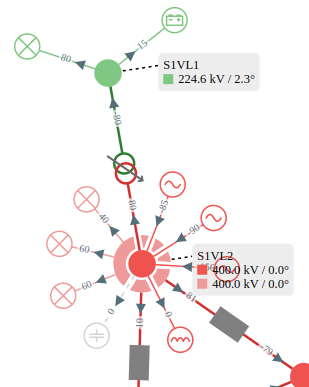
The loop edges points are computed so that they are distributed between branch edges when the space available is big enough.

Injections#
If injections are displayed, the injection edge points are computed similarly to loops: they are distributed between branch edges when the space available is big enough.
Three-winding transformers#
The three-winding edge points are computed by finding a “leading” transformer edge and then placing the other edges at 120°. The leading edge is defined as the opposite edge of the smallest aperture.
StraightEdgeRouting feature#
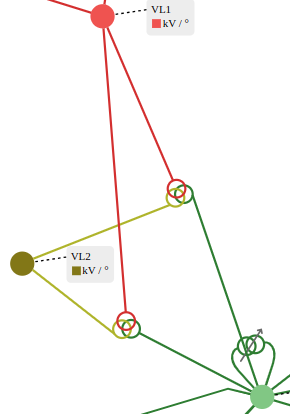
In the StraightEdgeRouting implementation,
the parallel edges points are computed so that they form a fork,
the other edges points are computed as straight lines.
CustomPathRouting feature#
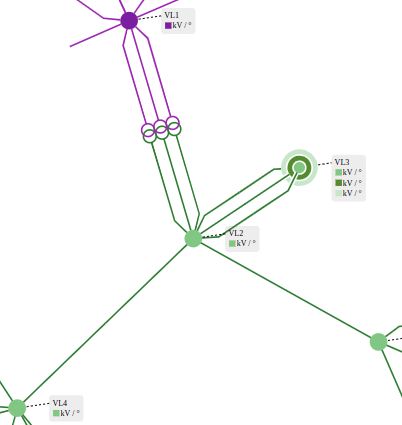
In the CustomPathRouting implementation, custom paths can be provided through two maps in the constructor
a map whose keys are branch ids and whose values are the list of “bending” points to add to the corresponding branch edge,
a map whose keys are voltage level ids and whose values are the list of “bending” points to add to the corresponding text edge.
If a branch id is missing in the given map, we fall back to StraightEdgeRouting implementation.
Similarly for text edges, if a voltage level id is missing in the corresponding map, we fall back to StraightEdgeRouting implementation.
