Network and subnetwork#
In the following sections, the different network components are described in terms of their main attributes and electrotechnical representation. The attributes shared by all the network components are described in the next table:
Attribute |
Description |
|---|---|
\(Id\) |
Unique Id assigned to each network component |
\(Name\) |
Human readable identifier (not necessary unique) |
\(Fictitious\) |
To identify non-physical network components |
\(Aliases\) |
Additional unique identifiers associated with each network component |
\(Properties\) |
To add additional data items to network components |
All equipment and the network itself are identified by a unique identifier which is the only required attribute. They can have a human-readable name. Offers the possibility of adding additional unique identifiers to each component. An alias can be qualified to indicate what it corresponds to.
Properties allow associating additional arbitrary data items under the general schema of pairs <Key, Value>.
To identify non-physical network components, one can use the fictitious property that is set to false by default.
A network can contain several subnetworks.
Validation level#
The validation level can be set to EQUIPMENT or STEADY_STATE_HYPOTHESIS. A network at equipment level is a network with missing steady-state hypotheses. This occurs just after SCADA systems, before any state estimation. Once all steady-state hypotheses are filled, meaning that a load flow engine has all the data needed to perform a computation, the validation level switches to STEADY_STATE_HYPOTHESIS. For some processes, a minimal validation level of the network is required.
Network#

In the PowSyBl grid model, the Network contains substations, which themselves contain voltage levels.
Characteristics
Attribute |
Description |
|---|---|
\(SourceFormat\) |
Source format of the imported network model |
\(CaseDate\) |
Date and time of the target network that is being modeled |
\(ForecastDistance\) |
Number of minutes between the network generation date and the case date |
The SourceFormat attribute is a required attribute that indicates the origin of the network model automatically set by the importers. If the case date and the forecast distance cannot be found in the case file, the network is considered as a snapshot: the case date is set to the current date, and the forecast distance is set to 0.
Available extensions
Substation#
A substation represents a specific geographical location with equipment grouped in one or several voltage levels.
Characteristics
Attribute |
Description |
|---|---|
\(Country\) |
To specify in which country the substation is located |
\(GeographicalTags\) |
They make it possible to accurately locate the substation |
\(TSO\) |
To track to which Transmission System Operator the substation belongs |
All three attributes are optional.
Available extensions
Voltage level#
A voltage level contains equipment with the same nominal voltage. Two voltage levels may be connected through lines (when they belong to different substations) or through transformers (they must be located within the same substation).
Characteristics
Attribute |
Unit |
Description |
|---|---|---|
\(NominalVoltage\) |
kV |
Nominal base voltage |
\(LowVoltageLimit\) |
kV |
Low voltage limit magnitude |
\(HighVoltageLimit\) |
kV |
High voltage limit magnitude |
\(TopologyKind\) |
Level of connectivity detail |
Specifications
Only NominalVoltage and TopologyKind are required.
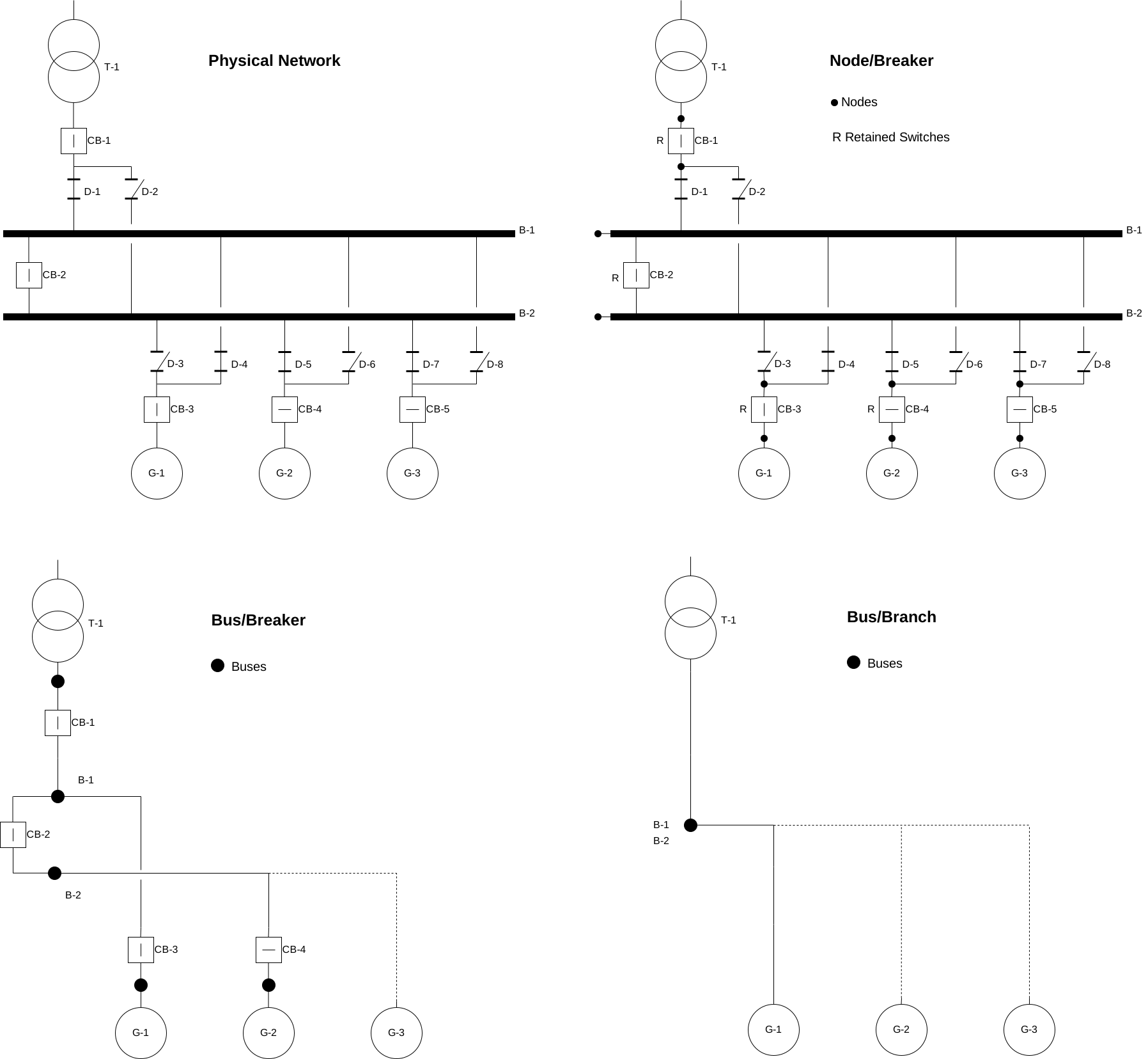
The connectivity in each voltage level of the network can be defined at one of two levels: node/breaker or bus/breaker. The connectivity level can be different in each voltage level of the model.
In node/breaker the connectivity is described with the finest level of detail and can provide an exact field representation. This level could be described as a graph structure where the vertices are Nodes and the edges are Switches (breakers, disconnectors) or internal connections. Each equipment is associated to one Node (busbar sections, loads, generators, ..), two Nodes (transmission lines, two-winding transformers, …) or three Nodes (three-winding transformers). Each Node can only have one associated equipment. Nodes do not have an alphanumeric Id or Name, they are identified by an integer.
Using bus/breaker the voltage level connectivity is described with a coarser level of detail. In this case the vertices of the graph are Buses, defined explicitly by the user. A Bus has an Id, and may have a Name. Each equipment defines the bus or buses to which it is connected. Switches can be defined between buses.
PowSyBl provides an integrated topology processor that allows to automatically obtain a bus/breaker view from a node/breaker definition, and a bus/branch view from a bus/breaker view or definition. It builds the topology views from the open/close status of Switches. Switches marked as retained in the node/breaker level are preserved in the bus/breaker view.
The following diagram represents an example voltage level with two busbars separated by a circuit breaker, a transformer connected to one of them and three generators that can connect to any of the two busbars. The three topology levels are shown.

When defining the model, the user has to specify how the different pieces of equipment connect to the network. If the voltage level is built at node/breaker level, the user has to specify a Node when adding equipment to the model. If the user is building using bus/breaker level, the Bus of the equipment must be specified. Using this information, the model creates a Terminal that will be used to manage the point of connection of the equipment to the network.
Available extensions
Area#
An Area is a geographical zone of a given type.
An Area is composed of a collection of voltage levels, and a collection of area boundaries.
Area boundaries can be terminals of equipments or Boundary objects from dangling lines.
The area type is used to distinguish between various area concepts of different granularity. For instance: control areas, bidding zones, countries…
A voltage level can belong to several areas, as long as all areas are of a different type.
The area boundaries define how interchange is to be calculated for the area.
Area interchange is calculated by summing the active power flows across the area boundaries and can be obtained for AC part only (considering only AC boundaries),
for DC part only (considering only DC boundaries) and in total (AC+DC).
Note that if the Area has no boundary explicitly defined, the interchange is considered 0MW.
For area types that are meant to be used for area interchange control, e.g., in Load Flow simulations, the interchange target of the area can be specified as an input for the simulation.
All area interchange values use the load sign convention: positive values indicate that the area is importing, negative values that the area is exporting.
Characteristics of an Area
Attribute |
Unit |
Description |
|---|---|---|
\(AreaType\) |
To specify the type of Area (eg. ControlArea, BiddingZone …) |
|
\(interchangeTarget\) |
MW |
Target active power interchange |
\(VoltageLevels\) |
List of voltage levels of the area |
|
\(AreaBoundaries\) |
List of area boundaries of the area |
Characteristics of an AreaBoundary
An area boundary is modeled by an AreaBoundary instance.
It is composed of either DanglingLine Boundary or a Terminal, and boolean telling if the area boundary
is to be considered as AC or DC.
The Ac flag is informative and is present to support the use case where boundaries are defined on AC components even though
the boundary is related to an HVDC link. An example for this is a DanglingLine (which is an AC equipment) that may actually represent
an HVDC interconnection that is not explicitly described in the network model. This information is used when computing area interchanges,
which are then separated for AC and DC parts.
Attribute |
Unit |
Description |
|---|---|---|
\(Area\) |
The area of this boundary |
|
\(Boundary\) |
Boundary of a DanglingLine (mutually exclusive with the Terminal attribute) |
|
\(Terminal\) |
Terminal of an equipment (mutually exclusive with the Boundary attribute) |
|
\(Ac\) |
True if AreaBoundary is to be considered AC, false otherwise |
Generator#
A generator is a piece of equipment that injects or consumes active power, and injects or consumes reactive power. It may be used as a controller to hold a voltage or reactive target somewhere in the network, not necessarily directly where it is connected. In that specific case, the voltage or reactive power control is remote.

Characteristics
Attribute |
Unit |
Description |
|---|---|---|
\(MinP\) |
MW |
Minimum generator active power output |
\(MaxP\) |
MW |
Maximum generator active power output |
\(ReactiveLimits\) |
MVar |
Operational limits of the generator (P/Q/V diagram) |
\(RatedS\) |
MVA |
The rated nominal power |
\(TargetP\) |
MW |
The active power target |
\(TargetQ\) |
MVAr |
The reactive power target at local terminal |
\(TargetV\) |
kV |
The voltage target at regulating terminal |
\(RegulatingTerminal\) |
Associated node or bus for which voltage is to be regulated |
|
\(VoltageRegulatorOn\) |
True if the generator regulates voltage |
|
\(EnergySource\) |
The energy source harnessed to turn the generator |
|
\(IsCondenser\) |
True if the generator may behave as a condenser |
Specifications
The values MinP, MaxP and TargetP are required. The minimum active power output cannot be greater than the maximum active power output. TargetP must be inside this active power limits. RatedS specifies the nameplate apparent power rating for the unit, it is optional and should be a positive value if it is defined. The reactive limits of the generator are optional, if they are not given the generator is considered with unlimited reactive power. Reactive limits can be given as a pair of min/max values or as a reactive capability curve.
The VoltageRegulatorOn attribute is required. It voltage regulation is enabled, then TargetV and RegulatingTerminal must also be defined. If the voltage regulation is disabled, then TargetQ is required. EnergySource is optional, it can be: HYDRO, NUCLEAR, WIND, THERMAL, SOLAR or OTHER.
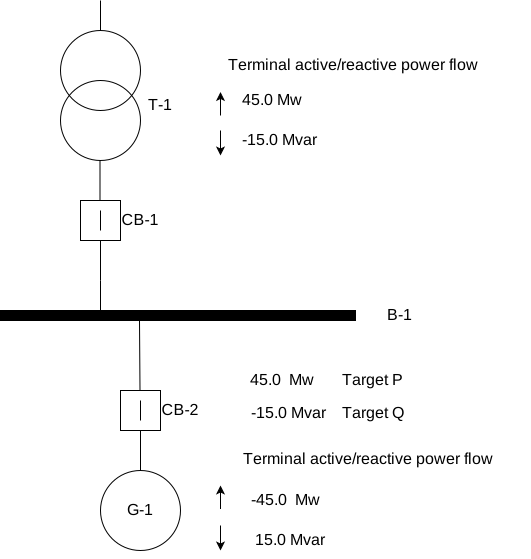
Target values for generators (TargetP and TargetQ) follow the generator sign convention: a positive value means an injection into the bus. Positive values for TargetP and TargetQ mean negative values at the flow observed at the generator Terminal, as Terminal flow always follows load sign convention. The following diagram shows the sign convention of these quantities with an example.
The isCondenser value corresponds for instance to generators which can control voltage even if their targetP is equal to zero.
Available extensions
Load#
A load is a passive equipment representing a delivery point that consumes or produces active and reactive power.
Characteristics
Attribute |
Unit |
Description |
|---|---|---|
\(P0\) |
MW |
The active power setpoint |
\(Q0\) |
MVar |
The reactive power setpoint |
Specifications
Initial values for loads P0 and Q0 follow the passive-sign convention:
Flow out from the bus has a positive sign.
Consumptions are positive.
Metadata In the grid model, loads comprise the following metadata:
The load type, which can be:
UNDEFINEDAUXILIARYFICTITIOUS
The load model, which can be:
ZIP(or polynomial), following equations:\[P = P0 * (c0p + c1p \times (v / v_0) + c2p \times (v / v_0)^2)\]\[Q = Q0 * (c0q + c1q \times (v / v_0) + c2q \times (v / v_0)^2)\]with \(v_0\) the nominal voltage.
Sum of \(c0p\), \(c1p\) and \(c2p\) must be equal to 1.
Sum of \(c0q\), \(c1q\) and \(c2q\) must be equal to 1.EXPONENTIAL, following equations:\[P = P0 \times (v / v_0)^{n_p}\]\[Q = Q0 \times (v / v_0)^{n_q}\]with \(v_0\) the nominal voltage.
\(n_p\) and \(n_q\) are expected to be positive.
Available extensions
Battery#
A battery on the electric grid is an energy storage device that is either capable of capturing energy from the grid or of injecting it into the grid. The electric energy on the grid side is thus transformed into chemical energy on the battery side and vice versa. The power flow is bidirectional, and it is controlled via a power electronic converter.
Characteristics
Attribute |
Unit |
Description |
|---|---|---|
\(P0\) |
MW |
The Constant active power |
\(Q0\) |
MVar |
The Constant reactive power |
\(MinP\) |
MW |
The Minimal active power |
\(MaxP\) |
MW |
The Maximum active power |
Available extensions
Dangling line#
A network may be connected to other networks for which a full description is not available or unwanted. In this case, a boundary line exists between the two networks. In the network of interest, that connection could be represented through a dangling line, which represents the part of that boundary line which is located in it. A dangling line is thus a passive or active component that aggregates a line chunk and a constant power injection in passive-sign convention. The active and reactive power set points are fixed: the injection represents the power flow that would occur through the connection, were the other network fully described.
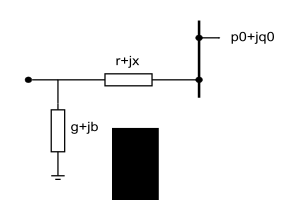
A generation part, at boundary side can also be modeled with a constant active power injection and a constant reactive power injection if the generation part of the dangling line is out of voltage regulation or a voltage target if the regulation is enabled. This fictitious generator can only regulate voltage locally: the regulating terminal cannot be set, it is necessary for the boundary side of the dangling line. Limits are modeled through \(MinP\) and \(MaxP\) for active power limits and through reactive limits. This generation part is optional. The generation part of the dangling line follows the classical generator sign convention.
Resulting flows at the dangling line terminal all follow the same passive-sign convention, either for the injection part or for the generation part.
Dangling lines are key objects for merging networks. Merging will be described soon here.
Characteristics
Attribute |
Unit |
Description |
|---|---|---|
\(P0\) |
MW |
The active power setpoint |
\(Q0\) |
MVar |
The reactive power setpoint |
\(R\) |
\(\Omega\) |
The series resistance |
\(X\) |
\(\Omega\) |
The series reactance |
\(G\) |
S |
The shunt conductance |
\(B\) |
S |
The shunt susceptance |
Optional:
Attribute |
Unit |
Description |
|---|---|---|
\(MinP\) |
MW |
Minimum generation part active power output |
\(MaxP\) |
MW |
Maximum generation part active power output |
\(ReactiveLimits\) |
MVar |
Operational limits of the generation part (P/Q/V diagram) |
\(TargetP\) |
MW |
The active power target |
\(TargetQ\) |
MVAr |
The reactive power target |
\(TargetV\) |
kV |
The voltage target |
\(VoltageRegulatorOn\) |
True if the generation part regulates voltage |
Specifications
\(P0\) and \(Q0\) are the active and reactive power setpoints
\(R\), \(X\), \(G\) and \(B\) correspond to a fraction of the original line and have to be consistent with the declared length of the dangling line.
In case the line is a boundary, a pairing key \(pairingKey\) (in previous network versions \(UcteXnodeCode\)) is defined beside the characteristics of the table. It is a key to match two dangling lines and reconstruct the full boundary line for both UCTE or CIM-CGMES formats.
A dangling line has a Boundary object that emulates a terminal located at boundary side. A dangling line is a connectable
with a single terminal located on the network side, but sometimes we need state variables such as active or reactive powers on
the other side, voltage angle and voltage magnitude at fictitious boundary bus. Note that \(P\), \(Q\), \(V\) and \(Angle\) at boundary
are automatically computed using information from the terminal of the dangling line.
Available extensions
Shunt compensator#
A shunt compensator represents a shunt capacitor or reactor or a set of switchable banks of shunt capacitors or reactors in the network. A section of a shunt compensator is an individual capacitor or reactor: if its reactive power (Q) is negative, it is a capacitor; if it is positive, it is a reactor.
There are two supported models of shunt compensators: linear shunt compensators and non-linear shunt compensators.
A linear shunt compensator has banks or sections with equal admittance values. A non-linear shunt compensator has banks or sections with different admittance values.
Shunt compensators follow a passive-sign convention:
Flow out from bus has positive sign.
Consumptions are positive.
Characteristics
Attribute |
Unit |
Description |
|---|---|---|
\(MaximumSectionCount\) |
- |
The maximum number of sections that may be switched on |
\(SectionCount\) |
- |
The current number of sections that are switched on |
\(B\) |
S |
The susceptance of the shunt compensator in its current state |
\(G\) |
S |
The conductance of the shunt compensator in its current state |
\(TargetV\) |
kV |
The voltage target |
\(TargetDeadband\) |
kV |
The deadband used to avoid excessive update of controls |
\(RegulatingTerminal\) |
- |
Associated node or bus for which voltage is to be regulated |
\(VoltageRegulatorOn\) |
- |
True if the shunt compensator regulates voltage |
For Linear Shunt Compensators
Attribute |
Unit |
Description |
|---|---|---|
\(bPerSection\) |
S |
The Positive sequence shunt (charging) susceptance per section |
\(gPerSection\) |
S |
The Positive sequence shunt (charging) conductance per section |
We expect \(bPerSection\) to be a non-zero value. The disconnected status of the linear shunt compensator can be modeled by setting the \(SectionCount\) attribute to zero.
For Non-Linear Shunt Compensators
Attribute |
Unit |
Description |
|---|---|---|
\(Sections\) |
The Partition of all the shunt compensator’s sections |
Section#
Attribute |
Unit |
Description |
|---|---|---|
\(B\) |
S |
The accumulated positive sequence shunt (charging) susceptance of the section if this section and all the previous ones are activated |
\(G\) |
S |
The accumulated positive sequence shunt (charging) conductance of the section if this section and all the previous ones are activated |
\(B\) and \(G\) attributes can be equal zero, but the disconnected status of the non-linear shunt compensator can be modeled by setting the \(SectionCount\) attribute to zero. The section which \(SectionCount\) equal to \(1\) is the first effective section, and it would be more efficient to affect it a non-zero susceptance.
Specifications
A section of a shunt compensator is an individual capacitor or reactor. A positive value of bPerSection means that it models a capacitor, a device that injects reactive power into the bus. A negative value of bPerSection means a reactor, a device that can absorb excess reactive power from the network.
The current section count is expected to be greater than one and lesser or equal to the maximum section count.
Regulation for shunt compensators does not necessarily model automation, it can represent human actions on the network e.g. an operator activating or deactivating a shunt compensator). However, it can be integrated on a power flow calculation or not, depending on what is wanted to be shown.
In the case of a capacitor, the value for its Q will be negative.
In the case of a reactor, the value for its Q will be positive.
Available extensions
Static VAR compensator#
It may be controlled to hold a voltage or reactive setpoint somewhere in the network (not necessarily directly where it is connected). Static VAR compensators follow a passive-sign convention:
Flow out from bus has positive sign.
Consumptions are positive.
Characteristics
Attribute |
Unit |
Description |
|---|---|---|
\(Bmin\) |
S |
The minimum susceptance |
\(Bmax\) |
S |
The maximum susceptance |
\(VoltageSetpoint\) |
kV |
The voltage setpoint |
\(ReactivePowerSetpoint\) |
MVar |
The reactive power setpoint |
Specifications
\(Bmin\) and \(Bmax\) are the susceptance bounds of the static VAR compensator. Reactive power output of a static VAR compensator is limited by the maximum and the minimum susceptance values. The min/max reactive power of a static VAR compensator is determined by:
\[Qmin = -Bmin \times V^2\]\[Qmax = -Bmax \times V^2\]where \(V\) is the voltage of the bus that connects the static VAR compensator to the network. Even if the regulating terminal is remote, only the local voltage has to be considered to retrieve the minimum and the maximum amount of reactive power. Reactive limits can be handled in an approximate way using the nominal voltage of the connected bus.
The voltage setpoint is required when the regulation mode is set to
VOLTAGE.The reactive power setpoint is required when the regulation mode is set to
REACTIVE_POWER.
Metadata In IIDM the static VAR compensator also comprises some metadata:
The regulation mode, which can be:
VOLTAGEREACTIVE_POWEROFF
Note that it is different from the generator regulation definition, which is only done through a boolean.OFFis equivalent to a disconnected element.
The regulating terminal, which can be local or remote: it is the specific connection point on the network where the setpoint is measured.
Available extensions
Line#
AC transmission lines are modeled using a standard \(\pi\) model with distributed parameters. A Line is a Branch, that models equipment with two terminals (or two sides). For the time being, a branch is an AC equipment.
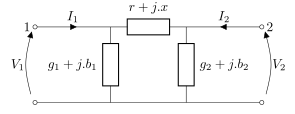

With series impedance \(z\) and the shunt admittance on each side \(y_1\) and \(y_2\):
The equations of the line, in complex notations, are as follows:
Characteristics
Attribute |
Unit |
Description |
|---|---|---|
\(R\) |
\(\Omega\) |
The series resistance |
\(X\) |
\(\Omega\) |
The series reactance |
\(G1\) |
S |
The first side shunt conductance |
\(B1\) |
S |
The first side shunt susceptance |
\(G2\) |
S |
The second side shunt conductance |
\(B2\) |
S |
The second side shunt susceptance |
Metadata
Lines can have loading limits.
Available extensions
Tie line#
A tie line is an AC line sharing power between two neighbouring regional grids. It is created by pairing two dangling lines with the same pairing key. It has line characteristics, with \(R\) (resp. \(X\)) being the sum of the series resistances (resp. reactances) of the two dangling lines. \(G1\) (resp. \(B1\)) is equal to the first dangling line’s \(G1\) (resp. \(B1\)). \(G2\) (resp. \(B2\)) is equal to the second dangling line’s \(G2\) (resp. \(B2\)).
Characteristics
Attribute |
Unit |
Description |
|---|---|---|
\(R\) |
\(\Omega\) |
The series resistance |
\(X\) |
\(\Omega\) |
The series reactance |
\(G1\) |
S |
The first side shunt conductance |
\(B1\) |
S |
The first side shunt susceptance |
\(G2\) |
S |
The second side shunt conductance |
\(B2\) |
S |
The second side shunt susceptance |
A tie line is not a connectable. It is just a container of two underlying dangling lines with the same pairing key. When connected together, each dangling line P0 and Q0 (and generation part if present) is ignored: only global tie line characteristics are used to compute flow. Removing a tie line leads to two free dangling lines, with an optional update of P0 and Q0 to match the flows in the global network context.
Transformers#
Two-winding transformer#
A two-winding power transformer is connected to two voltage levels (side 1 and side 2) that belong to the same substation. Two winding transformers are modeled with the following equivalent \(\Pi\) model:
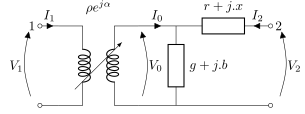

With the series impedance \(z\) and the shunt admittance \(y\) and the voltage ratio \(\rho\) and the angle difference \(\alpha\) and potential parameters from the current step of a ratio tap changer and/or a phase tap changer, we have:
Using the above notation, the equations of the two-winding transformers, in complex notations, are as follows:
Characteristics
Attribute |
Unit |
Description |
|---|---|---|
\(R_{nom}\) |
\(\Omega\) |
The nominal series resistance at the side 2 of the transformer |
\(X_{nom}\) |
\(\Omega\) |
The nominal series reactance at the side 2 of the transformer |
\(G_{nom}\) |
S |
The nominal magnetizing conductance at the side 2 of the transformer |
\(B_{nom}\) |
S |
The nominal magnetizing susceptance at the side 2 of the transformer |
\(V_{1\ nom}\) |
kV |
The rated voltage at side 1 |
\(V_{2\ nom}\) |
kV |
The rated voltage at side 2 |
\(RatedS\) |
MVA |
The normal apparent power |
Specifications
A ratio tap changer and/or a phase tap changer can be associated with a two-winding power transformer.
For a two-winding transformer, the normal apparent power shall be identical at both sides 1 and 2.
Available extensions
Three-winding transformer#
A three-winding power transformer is connected to three voltage levels (side 1, side 2 and side 3) that belong to the same substation. We usually have:
Side 1 as the primary side (side with the highest rated voltage)
Side 2 as the secondary side (side with the medium rated voltage)
Side 3 as the tertiary side (side with the lowest rated voltage)
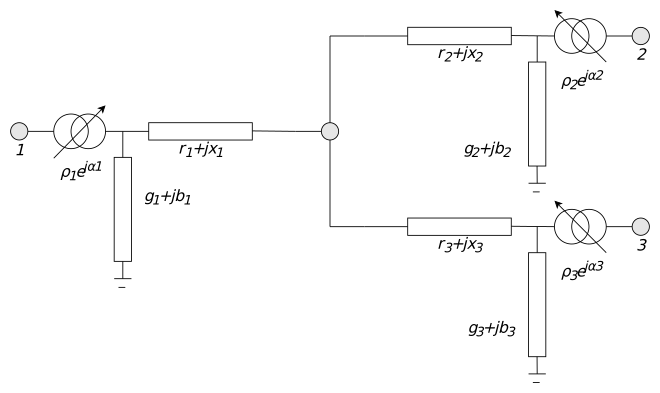
A three-winding transformer is modeled with three legs, where every leg model is electrically equivalent to a two-winding transformer. For each leg, the network bus is at side 1 and the star bus is at side 2.
Characteristics
Attribute |
Unit |
Description |
|---|---|---|
\(RatedU0\) |
kV |
The rated voltage at the star bus |
Specifications
A ratio tap changer and/or a phase tap changer can be associated to all three sides of a three-winding power transformer. Only one tap changer (either ratio or phase tap changer) is allowed to be regulating on the equipment at a given time.
Available extensions
Three-winding transformer leg#
Characteristics
Attribute |
Unit |
Description |
|---|---|---|
\(R\) |
\(\Omega\) |
The nominal series resistance specified at the voltage of the leg |
\(X\) |
\(\Omega\) |
The nominal series reactance specified at the voltage of the leg |
\(G\) |
S |
The nominal magnetizing conductance specified at the voltage of the leg |
\(B\) |
S |
The nominal magnetizing susceptance specified at the voltage of the leg |
\(RatedU\) |
kV |
The rated voltage |
\(RatedS\) |
MVA |
The normal apparent power |
Specifications
A leg can have loading limits.
HVDC line#
An HVDC line is connected to the DC side of two HVDC converter stations, either an LCC station or a VSC station.
Characteristics
Attribute |
Unit |
Description |
|---|---|---|
\(R\) |
\(\Omega\) |
The resistance of the HVDC line |
\(NominalV\) |
kV |
The nominal voltage |
\(ActivePowerSetpoint\) |
MW |
The active power setpoint |
\(MaxP\) |
MW |
The maximum active power |
Specifications
The HVDC line operation depends on a converter mode, which indicates the flow direction. In the specification it is thus mandatory to define
ConvertersMode, which can be:SIDE_1_RECTIFIER_SIDE_2_INVERTER: the flow goes from side 1 to side 2SIDE_1_INVERTER_SIDE_2_RECTIFIER: the flow goes from side 2 to side 1
The flow sign is thus given by the type of the converter station: the power always flows from the rectifier converter station to the inverter converter station. At a terminal on the AC side,
PandQfollow the passive sign convention.Pis positive on the rectifier side.Pis negative at the inverter side.The active power setpoint and the maximum active power should always be positive values.
Available extensions
HVDC converter station#
An HVDC converter station converts electric power from high voltage alternating current (AC) to high-voltage direct current (HVDC), or vice versa. Electronic converters for HVDC are divided into two main categories: line-commutated converters (LCC) and voltage-sourced converters (VSC).
Characteristics
Attribute |
Type |
Unit |
Required |
Default value |
Description |
|---|---|---|---|---|---|
HvdcType |
|
- |
yes |
- |
The HVDC type |
LossFactor |
float |
% |
yes |
- |
The loss factor |
The LossFactor should be greater than 0.
Specifications
The HVDC type, LCC or VSC, determines if the Converter Station is an LCC Converter Station or a VSC Converter Station.
The positive loss factor LossFactor is used to model the losses during the conversion. In case of:
A rectifier operation (conversion from AC to DC), we have
\[\frac{P_{DC}}{P_{AC}} = 1 - \frac{LossFactor}{100}\]An inverter operation (conversion from DC to AC), we have
\[\frac{P_{AC}}{P_{DC}} = 1 - \frac{LossFactor}{100}\]Note that at the terminal on the AC side, \(Q\) is always positive: the converter station always consumes reactive power.
LCC converter station#
An LCC converter station is made with electronic switches that can only be turned on (thyristors). Below are some characteristics:
Use semiconductors which can withstand voltage in either polarity
Output voltage can be either polarity to change the power direction
Current direction does not change
Store energy inductively
Use semiconductors which can turn on by control action
Turn-off and commutation rely on the external circuit
Characteristics
Attribute |
Unit |
Description |
|---|---|---|
\(PowerFactor\) |
% |
Ratio between the active power \(P\) and the apparent power \(S\). |
Available extensions
VSC converter station#
A VSC converter station is made with switching devices that can be turned both on and off (transistors). Below are some characteristics:
Use semiconductors which can pass current in either direction
Output voltage polarity does not change
Current direction changes to change the power direction
Store energy capacitively
Use semiconductors which can turn on or off by control action
Turn-off is independent of external circuit
Characteristics
Attribute |
Unit |
Description |
|---|---|---|
\(VoltageSetpoint\) |
kV |
The voltage setpoint for regulation |
\(ReactivePowerSetpoint\) |
MVar |
The reactive power setpoint for regulation |
Specifications
The voltage setpoint (in kV) is required if the voltage regulator is on for the VSC station.
The reactive power setpoint (in MVar) is required if the voltage regulator is off for the VSC station. A positive value of \(ReactivePowerSetpoint\) means an injection into the bus, thus a negative value at the corresponding terminal (which is in passive-sign convention).
A set of reactive limits can be associated to a VSC converter station. All the reactive limits modeling available in the library are described here.
Metadata
The participation in regulation (through a boolean)
Available extensions
Busbar section#
A busbar section is a non impedant element used in a node/breaker substation topology to connect equipment.
Available extensions
Breaker/switch#
A switch is a device designed to close or open one or more electric circuits. There are several types of switches:
breakers are capable of breaking currents under abnormal operating conditions (e.g. short-circuit);
load break switches are capable of breaking currents under normal operating conditions;
and disconnectors can only make or break negligible current.
A switch has an attribute to say if it is open or closed.
Available extensions
Internal connection#
An internal connection is a zero-impedance connection between two elements in a voltage level.
Contrary to the switch, the internal connection does not have any attribute to say of it is open or closed.
Overload management systems#
An overload management system is an automation system that monitors current on a terminal, defined by an equipment and an optional side.
Based on the measured values, various strategies (referred as ‘trippings’ in the model) can be implemented to reduce the current.
In a given strategy, if the current exceeds a threshold, a switch can be opened or closed to resolve the violation.
The switch open or close operation could be modeled using a switch ID, an association of a branch ID and a side, or an association of a three-windings transformer ID and a side.
Overload management system Characteristics
Attribute |
Unit |
Description |
|---|---|---|
\(Substation\) |
The substation associated where the system is installed |
|
\(MonitoredElementId\) |
The network element on which the limit will be monitored |
|
\(MonitoredSide\) |
The side of the element that is monitored |
Tripping Characteristics
The supported trippings are:
Branch tripping,
Switch tripping,
and three-windings transformer tripping.
Attribute |
Unit |
Description |
|---|---|---|
\(Type\) |
The type of tripping (e.g. BranchTripping, SwitchTripping, …) |
|
\(CurrentLimit\) |
A |
The current limit for which the action will be triggered |
\(Key\) |
The tripping key |
|
\(OpenAction\) |
bool |
Whether the tripping should be opened or closed |