HVDC
Definition
HVDC lines are modeled using HvdcLine of the IIDM PowSyBl network model, and an HVDC Range Action will always point to an HVDC line.
An HVDC line can operate in two modes:
Fixed Setpoint Mode
In this mode, the power flow on the HVDC line is directly controlled via its active power setpoint.AC Emulation Mode
The HVDC line operates in AC Emulation mode when the extension is enabled. In this mode, the flow is determined by the phase difference:
and ignores the active power setpoint and converters mode.
Implication:
An HVDC range action moves the active setpoint field of the HVDC line. When a line is in AC Emulation mode, applying an HVDC range action has no effect because the line cannot be directly controlled via its active power setpoint.
In order to use and optimize the setpoint of an HVDC range action, the HVDC line associated needs to be switched to fix setpoint mode before hand more info on that in the following sections.For the same reason, attempting to define a sensitivity for an HVDC range action with a line still in AC emulation will result in an OLF error. See Open Load Flow documentation.
HVDC range action setpoint field vs HVDC line active power setpoint field
First read powsybl specification on the flow sign convention for HVDC line.
For HVDC line the two things to note are that in fixed setpoint mode:
The active power setpoint field should always be positive
The flow direction is given by the converter mode
Whereas HVDC range action setpoint is not always positive. The setpoint follows the following convention:
If setpoint \(>\) 0, side 1 is the rectifier \(\rightarrow\) the flow goes from side 1 to side 2
If setpoint \(\leq\) 0, side 1 is the inverter \(\rightarrow\) the flow goes from side 2 to side 1
HVDC Range Action in some capacity calculation processes
Italy Nord Process (CSE CRAC)
As HVDC line cannot be modeled in UCTE format, an equivalent model is used: the HVDC is represented through two injections (one on each side of the line, with opposite keys of 1 and -1) as illustrated in the following diagram.
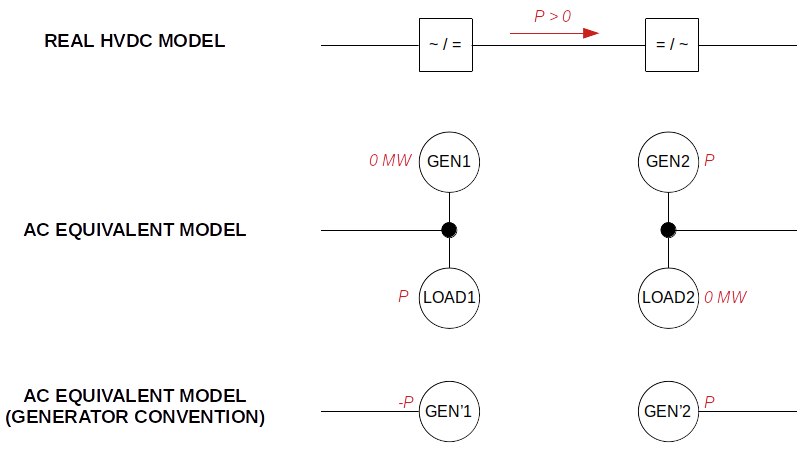
By doing this, the HVDC line is always considered in fixed setpoint mode.
For more information on how HVDC range actions are handled, see Gridcapa IN Process.
For details on how they are defined in CRAC, see CSE CRAC documentation.
✅ All issues related to AC Emulation do not affect this process, as there is no HVDC line element in the network
SWE Process (CIM CRAC)
In this process, contrary to previous modelization, HVDC lines are represented in the CGMES network, thus HVDC range actions are linked to a real HVDC line element.
HVDC range actions are typically handled in groups of two aligned actions.
Aligned HVDC range actions share the same group ID, meaning they must have the same setpoint.
For details on their definition in CRAC, see CIM CRAC documentation.
Currently, this range action is only imported in auto instant.
HVDC in Castor, the RAO Algorithm
We now support the optimization of HVDC range actions in preventive, auto and curative instants.
Managing HVDC Setpoints to Avoid Network Imbalance
⚠️ Warning
In the initial network, if the HVDC line is in AC Emulation mode, its active power setpoint will likely be random, as it does not affect network balance.
When AC Emulation is deactivated, the HVDC line follows its active power setpoint. If this setpoint is extreme or unrealistic, it can unbalance the network, potentially causing sensitivity calculations to fail to converge.
To prevent network imbalance when deactivating AC Emulation, follow this HVDC Setpoint Initialization procedure:
Run a Load Flow with the HVDC line in AC Emulation mode.
Record the power flow on the HVDC line from the network.
Deactivate AC Emulation.
Set the active power setpoint of the HVDC line to the previously recorded flow.
⚡ Note: This issue only arises if a sensitivity calculation is required immediately after AC emulation deactivation, before updating the HVDC line active power setpoint.
Pre-Treatment
Creating acEmulationDeactivationAction
If an HVDC Range Action uses a line in AC Emulation mode, a corresponding network action called acEmulationDeactivationAction with the same usage rule is created. Only one acEmulationDeactivationAction is created per HVDC line.
This network action allows the RAO to identify the optimal solution between:
Keeping the HVDC line in AC Emulation mode, or
Switching to fixed setpoint mode and optimizing the setpoint via the MIP.
HVDC Range Action Initially in AC Emulation — Initial Setpoint
At the very beginning of the RAO, a load flow is run to update the initial setpoint of HVDC range actions starting in AC Emulation mode.
Since the initial setpoint is now read from the network during CRAC deserialization, this step ensures a meaningful and realistic initial setpoint.
HVDC Range Action Optimization in Preventive and Curative Instants
At the root of each search tree (preventive or curative), a load flow is run.
For a given leaf, if an acEmulationDeactivationAction is applied, the HVDC line’s active setpoint is updated in the network.
The HVDC Range Action is available in the MIP only if the HVDC line is not in AC Emulation mode; otherwise, it is filtered out before each MIP.
HVDC Range Action in Auto Instant
Unlike other network actions, the acEmulationDeactivationAction is not automatically applied.
AC Emulation is deactivated only if optimization or use of the HVDC range action is required for automaton perimeter security.
After updating the setpoint, a sensitivity calculation is run, and the HVDC range action is optimized like any other range action. See Castor documentation.
Additional Warnings
Terminology: An HVDC line can be in AC Emulation mode even if the load flow is run in DC mode; these concepts are independent. See powsybl-open-loadflow documentation.
⚠️ WARNING ⚠️
OpenLoadFlow support DC loadflow run with HVDC lines in AC Emulation mode. However, it does NOT support DC sensitivity calculation with HVDC lines in AC Emulation mode ! Meaning that the
hvdcAcEmulationparameter will automatically be set tofalsein such cases in OLF’s code and the HVDC lines will be considered in fixed setpoint mode.So be careful when using HVDC lines in AC Emulation mode with DC sensitivity calculation.
Loadflow parameter
hvdcAcEmulation: This should always betrue, if set tofalseall the HVDC lines’ angle-droop active power control extension are ignored and all the lines are considered in fixed setpoint mode. See PowSyBl Core documentation.